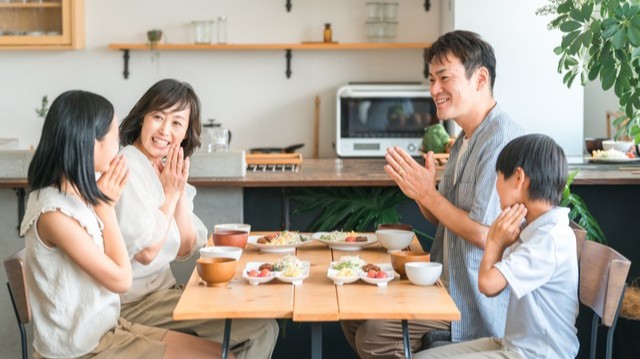
食事の際に用いられる「いただきます」という挨拶は、現在では日本社会に広く浸透しているものの、その起源や普及の過程については必ずしも明らかではない。
The greeting itadakimasu, which is used at mealtimes, is deeply rooted in contemporary Japanese society, but its origins and the process by which it became widespread are not yet fully understood.
。
Recently, discussions about the origin of itadakimasu have been increasingly active on social media, and the research results of Yasushiro Kondo, an honorary professor at Aoyama Gakuin University and a Japanese language scholar, are attracting particular attention.
。
Mr. Kondo questioned the reliability of the hypothesis that the phrase itadakimasu expresses gratitude toward the ingredients and the chef.
。
In fact, when an empirical investigation was conducted using the National Diet Library Digital Collection, he discovered that the earliest example of itadakimasu being used as a greeting was found in Shōgakkō Reihō Kyōjuhō Yōryaku oyobi Saimoku author: Seiichi Igata, published in Taisho 6 1917.
。
In that context, it is stated under Things to Know During Meals that you should say itadakimasu at the beginning of a meal and gochisousama at the end, and it is shown that this is used in school education settings.
。
Furthermore, according to Mr. Kondo, the modern meaning of itadakimasu began to spread about 100 years ago, and there is a high possibility that the government at the time intentionally promoted it as part of modern education.
。
In the process of researching the earliest examples of many words as an editorial board member of the Nihon Kokugo Daijiten Shogakukan, he noticed that there was very little information about itadakimasu, which led to this investigation.
。
What became clear during the course of the investigation was that expressions such as itadakimasu and choudai itashimasu can also be found in older materials, such as Childrens Discipline compiled by Takasaburō Kihara in 1891 Meiji 24, the 1904 Meiji 37 ethics textbook, and the 1907 Meiji 40 elementary school etiquette book.
。
However, these records indicate that itadakimasu had not yet become widely used in society at that time.
。
If that is a common custom, there is no need to state it so explicitly, and it may be intended to promote the views of a certain hierarchy or author.
。
Furthermore, with the spread of school lunches that began in Yamagata Prefecture in 1889 Meiji 22, the fact that itadakimasu came to be taught in textbooks on morals and etiquette may be related to the need for a standardized greeting throughout the country.
。
Triggered by Mr. Kondos social media post, there were opinions pointing out that the custom of putting ones hands together when saying itadakimasu differs by region, and that it may be related to the Christian pre-meal prayer as part of the acceptance of Western culture during the Meiji era.
。
Especially in regions such as Kinki, Hokuriku, and Chugoku, the custom of pressing ones palms together gassho is particularly prominent, which may be influenced by local religious circumstances, such as the prevalence of Jodo Shinshu Buddhism.
。
In this way, the history of the word itadakimasu is not limited to a simple everyday greeting, but is also deeply connected to social backgrounds such as school education, religion, and the acceptance of Western culture.
。
Tracking changes in language helps us gain a deeper understanding of Japanese culture, and I hope that even more research will be conducted in the future.
。
Furthermore, the third edition of the Nihon Kokugo Daijiten, which Mr. Kondo participated in editing, is scheduled to release an interim version 2.1 in 2027 and to be completed in 2032.
。
Details about the revised schedule are updated as needed on Shogakukans Nihon Kokugo Daijiten Third Edition Start Page. Please refer to it if you are interested.


 Home
Home
 Video
Video
 JLPT Test
 Dictionary
 Lesson

 Topic
Topic