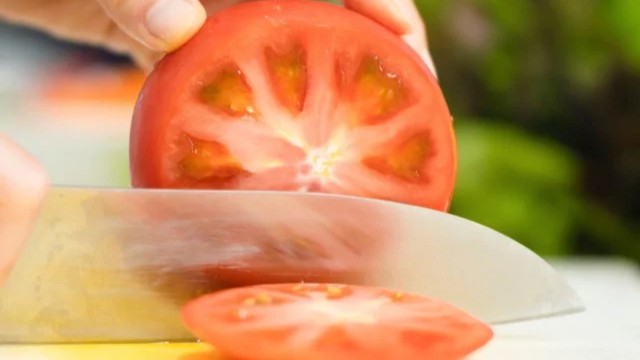
毎日使う包丁は、だんだん切れ味が悪くなります。
The kitchen knife you use every day gradually becomes less sharp.
。
If you use a dull knife, the ingredients will get crushed and your hand will get tired.
。
Normally, kitchen knives are sharpened with a whetstone, but what should I do if I dont have a whetstone at home?
。
In that case, you can use the back side of the porcelain.
。
There is usually a rough area on the underside of plates and cups.
。
First, wash that area thoroughly and wipe off any moisture.
。
After that, please place it in a stable location.
。
Next, tilt the blade of the knife slightly and gently touch it to the rough surface of the ceramic.
。
Please slide it slowly from the base to the tip.
。
Please repeat the same number of times for both sides of the blade.
。
If you press too hard, the blade may break, so please work gently.
。
This method is only a temporary measure, and it will only slightly improve the sharpness of the knife.
。
After use, please wash knives and ceramics thoroughly.
。
Also, please do not use this method on expensive knives.
。
If possible, regularly sharpen your kitchen knives using a whetstone or a specialized sharpener.


 Home
Home
 Video
Video
 JLPT Test
 Dictionary
 Lesson

 Topic
Topic