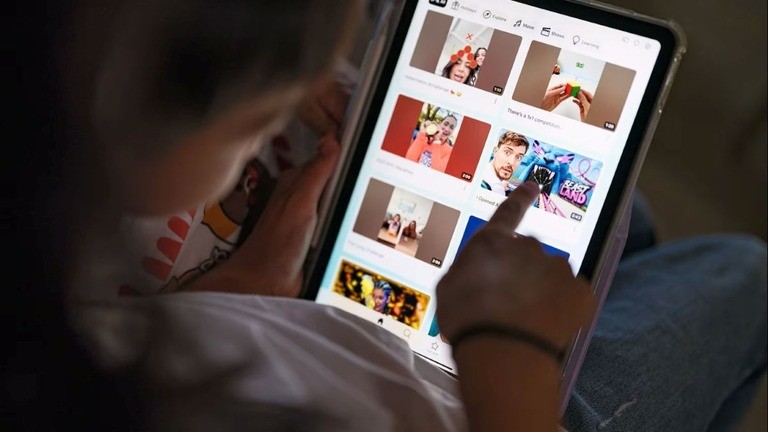
オーストラリアで16歳未満の児童に対するSNS利用を禁止するという、世界初の法律が7月10日に施行された。
For the first time in the world, a law banning social media use by children under the age of 16 was enacted in Australia on July 10.
。
On that day, Lucy Brooks, a 14-year-old cheerleader, temporarily lost contact with her friends on Snapchat.
。
However, within less than 24 hours, most of her friends came back, creating new accounts with fake ages, and some even used AI-generated fake ID photos to bypass the age verification technology.
。
The Australian government says that this measure is still only an initial best-effort obligation.
。
The goal is to prevent the sexual exploitation and bullying of children on the internet, as well as to reconsider the potential harmful effects that may spread through social media.
。
However, as experts point out, it is highly likely that alternative tools for the banned platforms will emerge soon.
。
Furthermore, in reality, its also very easy to return to the same platform.
。
Many minors, including Lucy, access social media with their parents consent, but there are also people who skillfully use AI-generated fake registration images to create new accounts one after another, so bans on social media use still arent a major obstacle.
。
Companies involved in age verification warn that even users who try to avoid ID checks will eventually be unable to escape regulation. However, it is said that with parental cooperation, access to the forbidden fruit is still very easy.
。
This bill is supported by activists with the aim of giving children back their childhood.
。
In reality, there are many threats on the internet, such as bullying, abuse, and sexual abuse.
。
The approach of strengthening regulations by the state to protect the dignity of its citizens and the approval or opposition of the people are two sides of the same issue; the promise that laws will ensure safety remains nothing more than an ideal.
。
This law takes effect without waiting for a court decision, which indicates a clear flaw.
。
Especially as artificial intelligence becomes increasingly widespread, this issue has become even more complex.
。
Australian courts have accepted numerous lawsuits related to the social media ban law, and the issue continues to be raised.
。
When a group of CNN reporters asked four 15-year-old boys in a park under a bridge about this ban, all four said they were still keeping their accounts.
。
They said that Snapchat is more convenient than TikTok because they can send messages freely without needing to exchange phone numbers, and they plan to keep using it as long as their accounts aren’t deleted.
。
Some users struggled with using TikTok, but as critics predicted, alternative tools for the ten banned platforms quickly emerged.
。
Unlike the other children, Lucy the cheerleader admits to consciously using social media.
。
While acknowledging the need to address problematic content on social media, she does not believe that a complete ban is the best solution.
。
She said that she learned a lot by using social media and thinks that gentle regulations, such as time limits, are ideal.
。
Many experts also support the opinion that appropriate usage time for childhood should be proposed in hours.
。
If children voluntarily follow the rules while cooperating with moral adults, then at the very least, excessively strict management measures would not be necessary.
。
The slogan So that children can be themselves only truly becomes persuasive when appropriate regulations are established and recognized by the government.


 Page d'accueil
 Vidéo
Vidéo
 Examen JLPT
 Dictionnaire
 Leçon
Leçon

 Sujet
Sujet