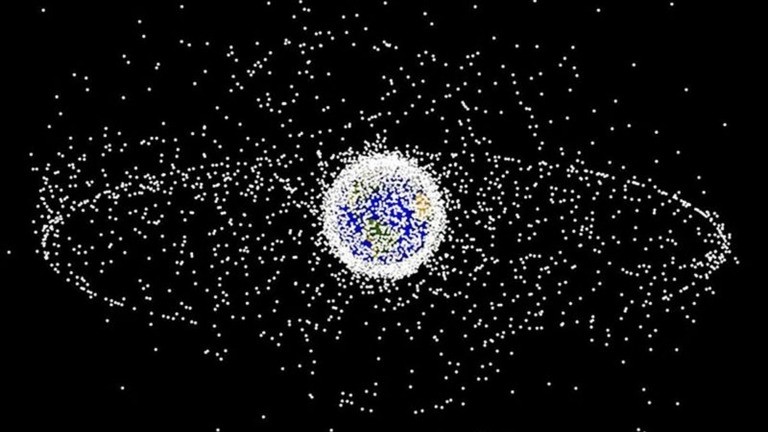
 What are the latest trends in research related to countermeasures that can be sustained to prevent the serious and destabilizing effects of increasing space debris?
In recent years, the increasing amount of space debris in outer space has become an extremely serious problem.
It is said that millions of objects, ranging from broken satellites and dislodged parts to even tiny bits of paint, are scattered all over Earth's orbit.
The International Space Station (ISS) has no choice but to avoid collisions with such space debris, and sometimes new debris is created when pieces of space debris collide with each other.
For this reason, although technologies for collecting and destroying space debris have been proposed, the current situation is that no comprehensive, systematic, and important countermeasures have been taken to date.
In response to this situation, researchers at the University of Surrey in the UK, Kenkyushara, have published a paper outlining new and more effective ways to deal with space debris.
The basic policy is to increase the sustainability of the space environment by reducing the amount of materials used, repairing existing objects in orbit that are difficult to repair, and recycling difficult-to-repair debris.
It is required that these measures be implemented in a systematic manner throughout the entire industrial sector.
Ideas such as ``reduce, reuse, and recycle'' are already common and commonplace all over the world, but it must be said that in the space industry, there is a need for new concepts.
Michael Dodge, a professor of cosmology at the University of North Dakota, has also pointed out its novelty.
According to data from the National Aeronautics and Space Administration (NASA), there are currently 25,000 pieces of space debris with diameters of just over 10 centimeters. It is estimated that there are more than 100 pieces of debris orbiting the earth, and if you include smaller pieces, the total number of pieces is estimated to exceed 100 million pieces.
According to the 2022 NASA report, the total weight of all space debris exceeds 10,000 tons.
The effects of space debris are enormous.
For example, in 1983, during Sally Ride's maiden flight on the Space Shuttle Challenger, there was a well-documented case of cracks resembling bullet holes appearing in the windows caused by space debris.
In addition, the Hubble Space Telescope's spacecraft has frequently collided with space debris, resulting in damage such as the parabolic antenna being penetrated.
Furthermore, in 2007 and 2009, large-scale collisions between artificial satellites occurred, and the debris generated at that time accounted for more than one-third of all the space debris currently recorded.
The danger of such a chain reaction is called the Kessler syndrome, and once the number of objects in a low orbit exceeds a certain limit, Each collision can lead to a chain reaction of new collisions, with the ultimate crisis threatening to leave the area filled with trash and unusable.
If no drastic, immediate solution to space debris is found, there will be great damage to satellites and the world's communications infrastructure. It has even been pointed out that there is a possibility that the world's global GDP could decline by 1.95% (according to an academic journal space policy paper published in 2023).
This year's papers will focus on building a sustainable space transport system, including a collision avoidance system for satellites that utilizes artificial intelligence (AI), and a space station for repairing and reusing space debris. It has been pointed out that there is a need to combine existing technologies with new ideas, such as repurposing them as a platform for new projects, and also for companies and nations to take into account disposal from the initial stage of designing objects.
However, establishing sustainability in outer space involves a unique set of challenges that do not exist anywhere on Earth.
Among these, in particular, the complexity of laws related to space and international politics has become a major barrier.
The Outer Space Treaty states that ``an object once launched into space remains the property of that country forever,'' and even spent rocket boosters and artificial satellites that have ceased operation are treated as the property of the country that launched them.
Therefore, it is currently considered illegal for a third country's Daisankoku to collect space debris produced by another country's octopus.
In order to proceed with the collection and reuse of space debris, permission will be required from all the owning countries, but this is extremely difficult in practical terms.
However, a separate article in the treaty imposes an obligation on each country to avoid contaminating space in space, leaving little room for interpretation that it is their responsibility to collect and collect space debris in their own countries.
Overcoming these legal and institutional hurdles and realizing the recycling and recycling of space debris will be extremely important for the sustainability of the country's space industry in the future.
Jin Xuan, Deputy Dean of the Faculty of Research, Health and Innovation at the University of Surrey, said: ``There is a lot of interest in the idea of sustainability, but in order to actually put it into practice, funding and incentives need to be put in place.''
What are the latest trends in research related to countermeasures that can be sustained to prevent the serious and destabilizing effects of increasing space debris?
In recent years, the increasing amount of space debris in outer space has become an extremely serious problem.
It is said that millions of objects, ranging from broken satellites and dislodged parts to even tiny bits of paint, are scattered all over Earth's orbit.
The International Space Station (ISS) has no choice but to avoid collisions with such space debris, and sometimes new debris is created when pieces of space debris collide with each other.
For this reason, although technologies for collecting and destroying space debris have been proposed, the current situation is that no comprehensive, systematic, and important countermeasures have been taken to date.
In response to this situation, researchers at the University of Surrey in the UK, Kenkyushara, have published a paper outlining new and more effective ways to deal with space debris.
The basic policy is to increase the sustainability of the space environment by reducing the amount of materials used, repairing existing objects in orbit that are difficult to repair, and recycling difficult-to-repair debris.
It is required that these measures be implemented in a systematic manner throughout the entire industrial sector.
Ideas such as ``reduce, reuse, and recycle'' are already common and commonplace all over the world, but it must be said that in the space industry, there is a need for new concepts.
Michael Dodge, a professor of cosmology at the University of North Dakota, has also pointed out its novelty.
According to data from the National Aeronautics and Space Administration (NASA), there are currently 25,000 pieces of space debris with diameters of just over 10 centimeters. It is estimated that there are more than 100 pieces of debris orbiting the earth, and if you include smaller pieces, the total number of pieces is estimated to exceed 100 million pieces.
According to the 2022 NASA report, the total weight of all space debris exceeds 10,000 tons.
The effects of space debris are enormous.
For example, in 1983, during Sally Ride's maiden flight on the Space Shuttle Challenger, there was a well-documented case of cracks resembling bullet holes appearing in the windows caused by space debris.
In addition, the Hubble Space Telescope's spacecraft has frequently collided with space debris, resulting in damage such as the parabolic antenna being penetrated.
Furthermore, in 2007 and 2009, large-scale collisions between artificial satellites occurred, and the debris generated at that time accounted for more than one-third of all the space debris currently recorded.
The danger of such a chain reaction is called the Kessler syndrome, and once the number of objects in a low orbit exceeds a certain limit, Each collision can lead to a chain reaction of new collisions, with the ultimate crisis threatening to leave the area filled with trash and unusable.
If no drastic, immediate solution to space debris is found, there will be great damage to satellites and the world's communications infrastructure. It has even been pointed out that there is a possibility that the world's global GDP could decline by 1.95% (according to an academic journal space policy paper published in 2023).
This year's papers will focus on building a sustainable space transport system, including a collision avoidance system for satellites that utilizes artificial intelligence (AI), and a space station for repairing and reusing space debris. It has been pointed out that there is a need to combine existing technologies with new ideas, such as repurposing them as a platform for new projects, and also for companies and nations to take into account disposal from the initial stage of designing objects.
However, establishing sustainability in outer space involves a unique set of challenges that do not exist anywhere on Earth.
Among these, in particular, the complexity of laws related to space and international politics has become a major barrier.
The Outer Space Treaty states that ``an object once launched into space remains the property of that country forever,'' and even spent rocket boosters and artificial satellites that have ceased operation are treated as the property of the country that launched them.
Therefore, it is currently considered illegal for a third country's Daisankoku to collect space debris produced by another country's octopus.
In order to proceed with the collection and reuse of space debris, permission will be required from all the owning countries, but this is extremely difficult in practical terms.
However, a separate article in the treaty imposes an obligation on each country to avoid contaminating space in space, leaving little room for interpretation that it is their responsibility to collect and collect space debris in their own countries.
Overcoming these legal and institutional hurdles and realizing the recycling and recycling of space debris will be extremely important for the sustainability of the country's space industry in the future.
Jin Xuan, Deputy Dean of the Faculty of Research, Health and Innovation at the University of Surrey, said: ``There is a lot of interest in the idea of sustainability, but in order to actually put it into practice, funding and incentives need to be put in place.''











Todaii Japanese is a website for learning and reading Japanese news integrating various features such as dictionary, practice, testing, ...
https://todaiinews.com
todai.easylife@gmail.com
(+84) 865 924 966
315 Truong Chinh, Khuong Mai, Thanh Xuan, Hanoi














 Home
Home
 Video
Video
 JLPT Test
 Dictionary
 Lesson

 Topic
Topic