米国航空宇宙局(NASA)が運用するハッブル宇宙望遠鏡と、欧州宇宙機関(ESA)の木星氷衛星探査機「Juice(ジュース)」は、恒星間天体「3I/ATLAS」の詳細な観測に相次いで成功した。
The Hubble Space Telescope operated by the National Aeronautics and Space Administration NASA and the Jupiter icy moon explorer Juice of the European Space Agency ESA have each succeeded in detailed observations of the interstellar object 3I/ATLAS.
。
3I/ATLAS was discovered this July as an object from outside the solar system, attracting significant attention in the astronomical community. Since this is only the third recorded case of an interstellar object passing through the solar system, many exploration missions have been assigned to this object.
。
The observational data obtained so far not only provide important information for determining the orbit of the celestial body, but also contribute to clarifying its origin through analysis of the components of gases that evaporated when it approached the Sun in October.
。
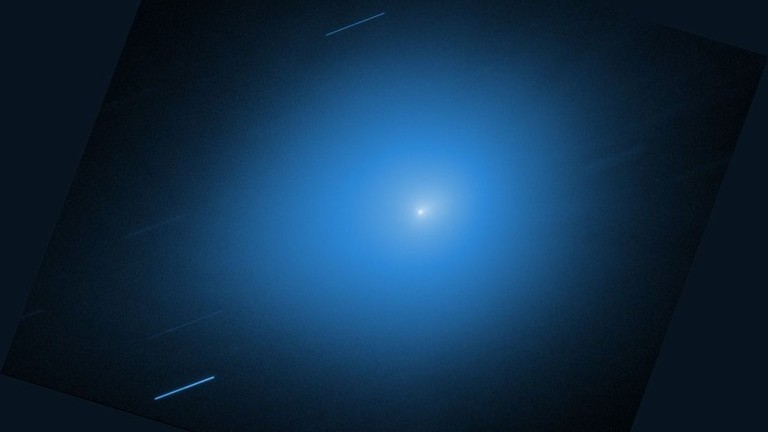
The Hubble Space Telescope captured the teardrop-like shape of 3I/ATLAS in great detail shortly after its discovery in July, and on November 30, when the object was about 286 million kilometers from Earth, it took higher-resolution photos using its wide-field camera.
。
The spacecraft JUICE, which is investigating the possibility of life on Jupiter and its icy moons Europa, Ganymede, and Callisto, observed intriguing activity near 3I/ATLAS.
。
Juice is scheduled to arrive at Jupiter in July 2031, but in early November, it conducted observations using five instruments and a navigation camera NavCam from a position about 66 million kilometers away from 3I/ATLAS.
。
However, during the long journey, Juice is using its main antenna as a shield to avoid heat from the Sun, so communication is limited to only the small antenna.
。
Therefore, most of the observational data is not expected to arrive on Earth until February 2024.
。
However, the operations team had previously downloaded a portion of the images taken by NavCam, equivalent to one-fourth of the total, and succeeded in recording the activity of 3I/ATLAS as it was activated by the heat of the sun.
。
In the newly released image, the coma the comets head surrounding 3I/ATLAS and its two tails can be clearly seen.
。
These two tails consist of a plasma tail made of electrically charged gas and a dust tail made of dust.
。
Such a double-tail and coma structure is also a phenomenon commonly seen in comets originating from the solar system. As a comet approaches the Sun, its components such as rocks, gas, dust, and ice evaporate and form a tail trailing behind.
。
3I/ATLAS will make its closest approach to Earth on December 19, coming within about 270 million kilometers, but since it will be on the opposite side of the Sun, it is said to have no direct impact on Earth.
。
This celestial body can be observed for the next few months, but after that, it is expected to leave the solar system.
。
The remaining data will be collected by Juice and is scheduled to arrive on Earth between February 18 and 20, 2024, including images from a high-resolution optical camera as well as data on the composition and particles of the comet.
。
Based on this information, further understanding of the origin and material characteristics of 3I/ATLAS is expected.


 Page d'accueil
 Vidéo
Vidéo
 Examen JLPT
 Dictionnaire
 Leçon
Leçon

 Sujet
Sujet