サハラ以南アフリカ出身とされ、「ファースト・ブラック・ブリトン」と呼ばれてきた古代女性が、実際には色白でイングランド南部出身であったことが、最新のDNA配列解析技術によって明らかとなった。
A woman from ancient times, once called the first Black Briton and thought to be from sub-Saharan Africa, has actually been revealed by the latest DNA sequencing technology to have had white skin and to have come from southern England.
。
The remains of this woman are known as the Beachy Head Woman and were discovered in 2012 among the collections at Eastbourne Town Hall.
。
According to the results of radiocarbon dating, it has been shown that she died during the Roman Empire, between AD 129 and 311.
。
In 2013, each part of her skull was measured, and based on traditional ancestry estimation methods, it was concluded that she was from sub-Saharan Africa, and she was recognized as the first black person in the British Isles.
。
However, later, a hypothesis was proposed based on low-level genetic sequence analysis in 2017 that she originated from the Mediterranean region.
。
Furthermore, thanks to the remarkable advances in science and technology, high-quality DNA analysis became possible, and as a result, it was revealed that she was actually born in southern England.
。
William Marsh, a population geneticist at the Natural History Museum in London and a principal co-author of this study, said, “This research shows that the genetic ancestry of this woman is very similar to that of the inhabitants of Roman-era Britain.”
。
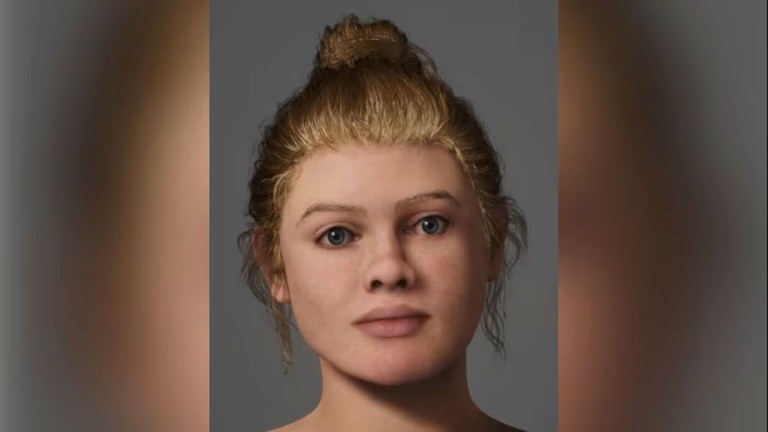
The research team created an image reconstructing the appearance of the Beachy Head woman by combining 3D scan data of her skull with DNA information.
。
The result was the appearance of a blonde woman with fair skin and blue eyes.
。
According to the analysis of her remains, she was under 152 cm tall, died between the ages of 18 and 25, had healed scars on her legs, and had suffered a serious injury that was not fatal.
。
Furthermore, the concentrations of carbon and nitrogen in her bones suggest that she may have once consumed a large amount of seafood.
。
Ms. Selina Brace leader of the Ancient DNA Research Team at the Natural History Museum in London and the lead author of this study stated, Thanks to the remarkable technological advances over the past decade since the discovery of the Beachy Head Woman, we are delighted to be able to report unprecedentedly comprehensive data, and expressed hope that further progress will continue to be made in uncovering the identity of this individual.
。
Furthermore, Pontus Skoglund, who leads the Ancient Genomics Laboratory at the Francis Crick Institute in London, also agreed with Dr. Braces views on technological advances and reflected, Back in 2013, analyses based on skull features were rare, and the field of ancient genomics itself was still in its developmental stage.
。
Archaeobiologist Thomas Booth from the same institute said, This study is a clear example of science being self-correcting. At the time, we made the most of the technology available to us, but the very method of cranial measurement analysis itself originated from attempts to establish a racial hierarchy system, and has caused much controversy.
。
This result provides an opportunity to re-examine the validity of those methods.
。
In this way, the advancement of modern ancient DNA analysis technology not only encourages a reevaluation of our understanding of human history and race, but also reaffirms that science is a process of constant self-correction.


 Home
Home
 Video
Video
 JLPT Test
 Dictionary
 Lesson

 Topic
Topic