大型陸生動物の中で、ゾウガメはかつて限界と考えられていた寿命を大きく超え、進化の過程で老化を著しく遅らせることに成功した稀有な存在である。
Among large terrestrial animals, the giant tortoise is a rare example that has greatly surpassed what was once considered the maximum lifespan, and has succeeded in significantly slowing the aging process through evolution.
。
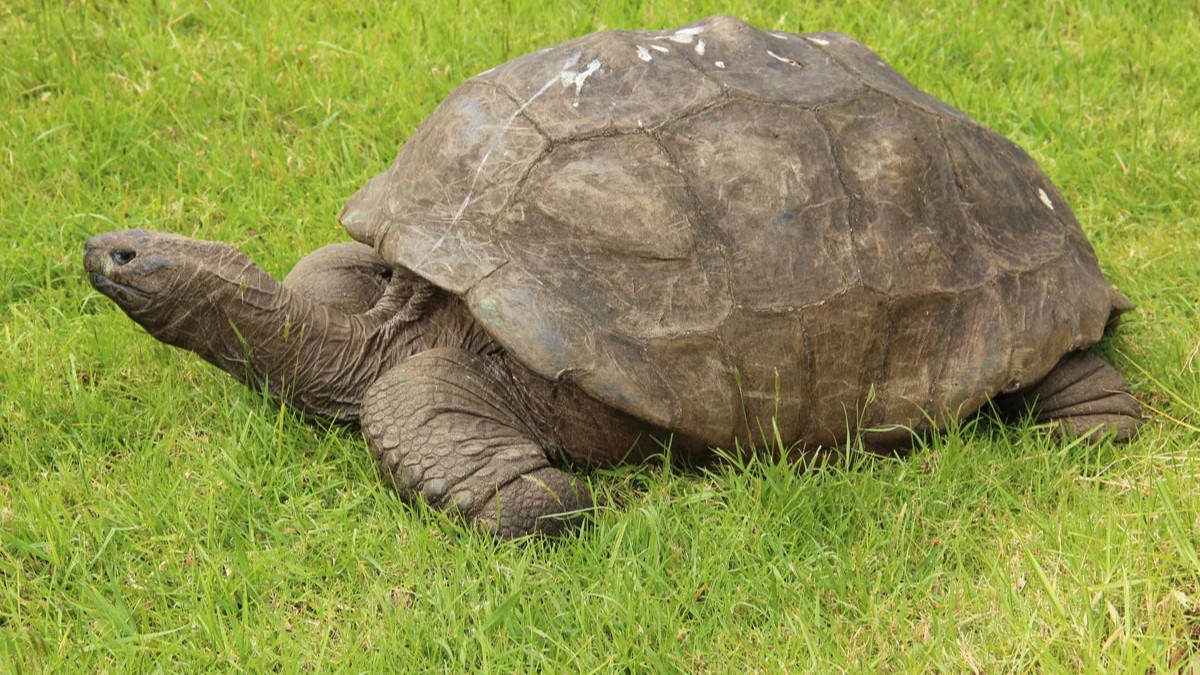
In particular, for the Aldabra giant tortoise scientific name: Aldabrachelys gigantea and the Galápagos giant tortoise scientific name: Chelonoides niger, it is not uncommon for them to live for 120 to 150 years or more, and there have even been individuals confirmed to have lived for about 200 years, such as Jonathan, who is kept on the island of Saint Helena.
。
However, even more noteworthy than this unusually long lifespan are the evolutionary adaptation mechanisms that enable these giant turtles to achieve such remarkable longevity.
。
Modern science is striving to unravel these fundamental mechanisms, and research on giant turtles provides extremely important clues to solving the mystery of maximum lifespan.
。
Jonathan is believed to have hatched around 1832 and is officially recorded as being 193 years old.
。
He was born in the Seychelles and has been protected there since he was transferred to the British territory of St. Helena in 1882.
。
Historical records and photographs from the 1880s confirm that he was already an adult, indicating that he was at least over 50 years old at that time.
。
Currently, Jonathan is still being kept on the grounds of the governors residence, and according to the veterinarian, despite being nearly 200 years old, he maintains his appetite and sociability, and shows no significant signs of physiological decline other than slightly diminished eyesight and hearing.
。
Notably, Jonathan is not an exception; all tortoises can live for 150 to 180 years, with aging progressing very slowly and deterioration kept to a minimum.
。
This phenomenon is thought to be the result of a combination of evolutionary traits, physiology, and genome that suppress cell damage and slow down the progression of aging.
。
First of all, the longevity of giant tortoises is supported by the island environment with few predators and an abundance of food sources.
。
In such a stable ecosystem, there is a selective advantage in surviving for a long time and growing slowly rather than reproducing in a short period.
。
According to a study published in Nature in 2014, giant tortoises age extremely slowly among vertebrates, and their mortality rate hardly increases with age.
。
Secondly, the low metabolic rate of giant tortoises also contributes to their longevity.
。
The amount of reactive oxygen species generated is low, oxidative stress is suppressed, and tissue deterioration progresses much more slowly compared to mammals.
。
According to physiological studies, reptiles possess powerful antioxidant defense mechanisms, which are a major factor in preventing the accumulation of damage caused by metabolism.
。
Third, according to a genome analysis published in 2019 in the journal Nature Ecology & Evolution, it was found that giant tortoises have expanded gene families related to DNA repair, immune system enhancement, antioxidant production, and tumor suppression.
。
These genetic adaptations are involved in the regulation of the cell cycle, the process of apoptosis, and the response to DNA damage, forming multilayered cellular defenses.
。
This mechanism shares similarities with other long-lived animals, while also exhibiting genetic structures unique to the Galápagos giant tortoise.
。
Fourth, giant turtles have remarkably developed mechanisms for maintaining intracellular homeostasis, such as proteostasis, autophagy, and mitochondrial function.
。
These processes are essential for preventing the accumulation of cellular damage and for maintaining youthful tissue function even in old age.
。
In this way, the characteristic of giant tortoises as hardly aging can be said to be the result of a combination of evolutionary adaptation, physiology, and genetics, and provides us with important clues that force us to reconsider the phenomenon of aging.


 Home
Home
 Video
Video
 JLPT Test
 Dictionary
 Lesson

 Topic
Topic