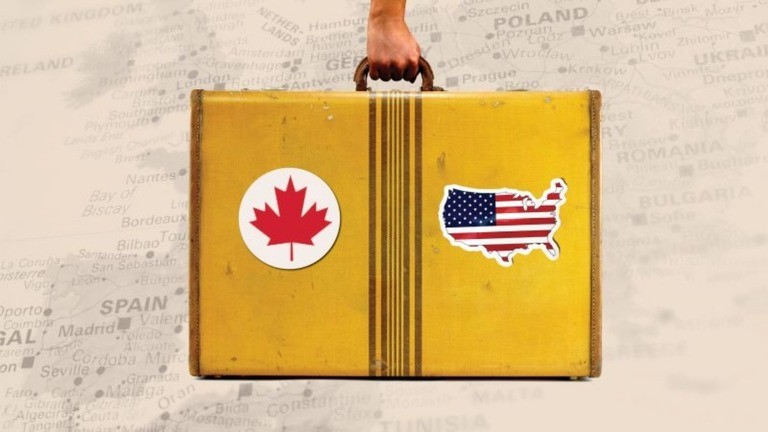
近年、海外旅行先においてカナダ人を装う米国人が急増している現象が注目されている。
In recent years, the phenomenon of Americans pretending to be Canadian while traveling abroad has been attracting attention.
。
The reason is said to be a desire to avoid anti-American sentiment in the international community, and this practice is called flag jacking. It began during the Vietnam War era in the 1960s and 1970s, became noticeable again during the Iraq War in the early 2000s, and has resurfaced recently under the Trump administration.
。
In fact, when Susanna Shankar went to Spain and claimed to be Canadian, she was suspected, and it was discovered that she was actually American.
。
Shankar holds dual citizenship in the United States and Canada. After spending his childhood in Alaska, USA, he moved to Vancouver, Canada via Germany.
。
However, the distinctive West Coast accent often reveals where she is from.
。
She herself pointed out, It may be that I am being suspected because many Americans pretend to be Canadian.
。
Many Canadians still criticize this behavior as cultural appropriation or insincerity.
。
In particular, on the internet, there are many opinions such as no one will be fooled or you can tell immediately if someone is American regarding Americans disguising their nationality by wearing the maple leaf symbol of the Canadian flag.
。
According to experts in the tourism industry, there are clear differences in behavior and attitudes between Americans and Canadians.
。
For example, European tour guides say, Canadians are modest and inconspicuous, while Americans are loud and outspoken.
。
Furthermore, Canadians tend to actively reveal their nationality so as not to be mistaken for Americans.
。
According to research by Professor Deyong Kim at the University of Missouri, travelers nationalities and their perceptions of a country greatly influence their behavior while traveling.
。
加えて、旅行会社のリー・バーンズ氏は「カナダ人は冒険心が強く新しい体験に積極的だが、米国人は組織的な行動を好み、不満があれば声高に主張する傾向がある」と指摘する。
カナダ人は不満を公然と表明することが少なく、静かに受け止める傾向があるのに対し、米国人は率直さが際立つ。
さらに、カナダは英連邦加盟国であり、仏蘭西系カナダ人の歴史的背景から欧州文化への理解が深いという点も、米国人との違いとして挙げられる。
実際、欧州の観光地では米国人旅行者が「行列を飛ばす」ことに強い関心を示し、追加料金を支払ってでも優遇を求める傾向が観察されている。
このように、両国民の行動や態度には歴史的背景や文化的価値観の違いが色濃く反映されており、たとえ外見や持ち物を偽ったとしても、その本質的違いは容易に見抜かれてしまうのが現状である。


 Page d'accueil
 Vidéo
Vidéo
 Examen JLPT
 Dictionnaire
 Leçon
Leçon

 Sujet
Sujet