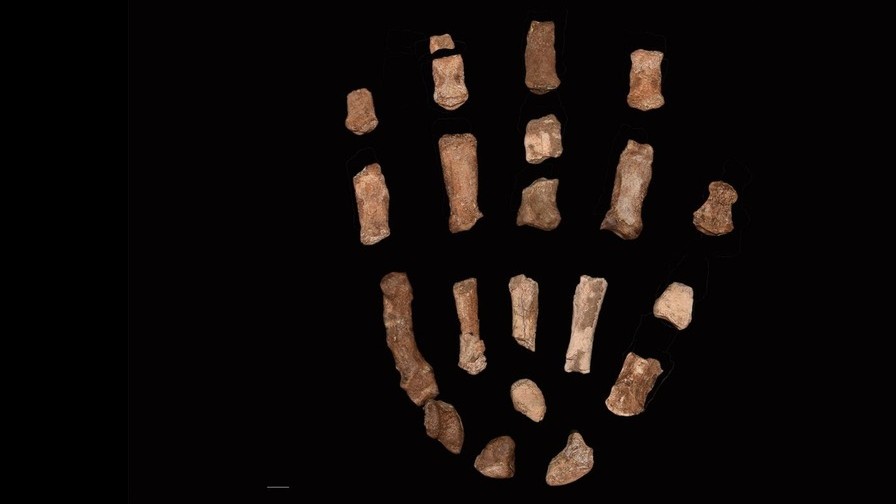
ケニアで「パラントロプス・ボイセイ」という絶滅した人類の近い親せきの手の化石が見つかりました。
Fossilized hand bones of Paranthropus boisei, an extinct close relative of humans, have been discovered in Kenya.
。
This fossil is estimated to be about 1.52 million years old and is believed to be of the same type as previously discovered skull and tooth specimens.
。
The bones of the hand have long thumbs, the fingers are straight, and even the little finger moves flexibly.
。
Therefore, Paranthropus boisei is believed to have had a strong grip and could hold objects firmly, much like modern humans.
。
This type of hand shape is also very similar to that of a gorilla.
。
This discovery proposed a new hypothesis that Paranthropus boisei may also have used stone tools.
。
It was previously believed that only the genus Homo made tools, but recent studies suggest that other species may have also used tools.
。
Paranthropus boisei lived in East Africa from about 2.6 million to 1.3 million years ago, during the same period as other human species.
。
Based on the hand bones, it is thought that this species was also able to climb trees, but the shape of their feet shows that they also walked on two legs.
。
From the shape and how they used their teeth, we can tell that they ate tough plants.
。
This fossil was discovered during excavation surveys conducted from 2019 to 2021.
。
This discovery offers new insights into human evolution and the use of tools.


 Page d'accueil
 Vidéo
Vidéo
 Examen JLPT
 Dictionnaire
 Leçon
Leçon

 Sujet
Sujet