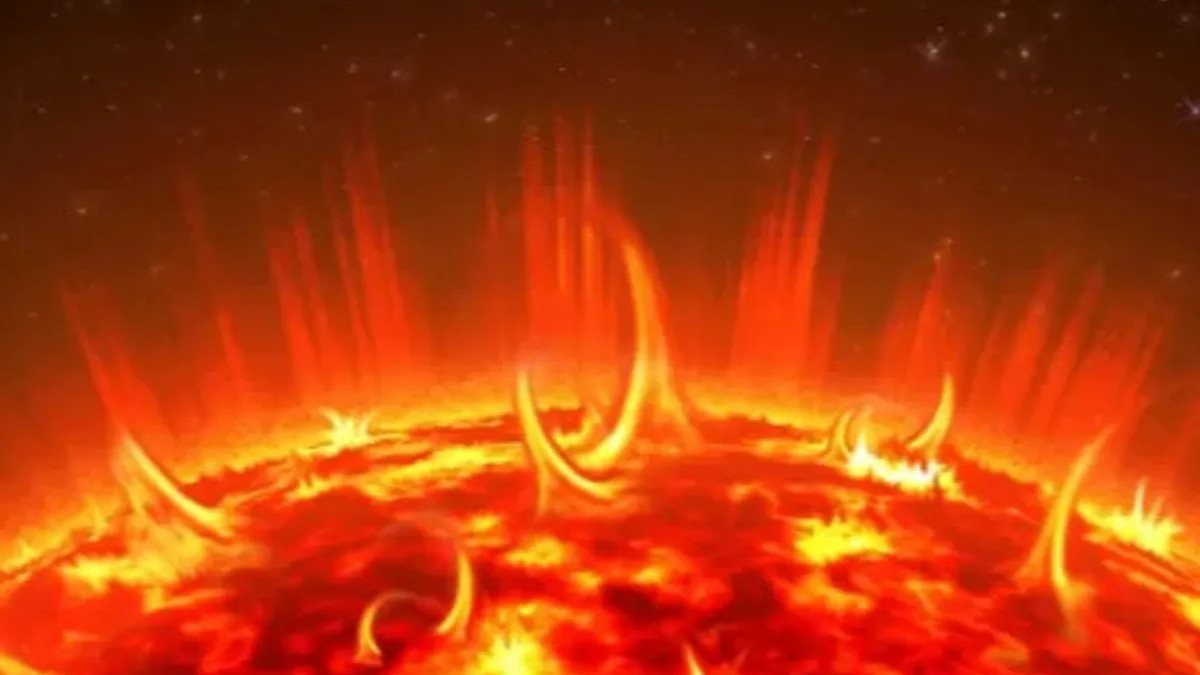
太陽表面で観測される「雨」とは、水ではなくプラズマが降下する現象を指す。
The phenomenon observed as rain on the surface of the sun is not water, but rather plasma pouring down.
。
The question, Why does rain on the Sun form so quickly? has puzzled astronomers for many years, but it has finally been solved by a research team from the University of Hawaii.
。
The corona around the Sun and the Sun’s outer layer are high-temperature environments that can reach millions of degrees, but the phenomenon in which cooled plasma rises again and falls onto the Sun’s surface is truly worthy of being called a “plasma rain.”
。
However, its rapid formation rate cannot be sufficiently explained by existing theories.
。
According to a study published in The Astrophysical Journal, previous solar models assumed that the composition of elements in the corona was constant, but it has now been revealed that the elemental ratios in the corona actually change over time.
。
Therefore, the radiative cooling efficiency is greatly affected by the type of element, and this is directly related to the rapid cooling process of the plasma and the formation of raindrops.
。
The research team at the University of Hawaii improved the existing plasma simulation tool HYDRAD by adding a function that can reflect the behavior of low ionization potential FIP elements such as iron, silicon, and magnesium.
。
The results indicate that as plasma rises along the magnetic loops of the corona, its elemental composition changes, and a rapid increase in emission near the loop tops triggers rapid cooling and condensation.
。
The clumps of plasma formed in this way fall back onto the surface of the Sun, and this is the true nature of the phenomenon known as solar rain.
。
Furthermore, observational data from the Japanese satellite Hinode also confirm the validity of this new model, indicating that the actual components of the rain plasma are very close to those on the solar surface.
。
Luke Benowitz, the lead author, said, Im very excited that by including variations of elements such as iron in the model, the observations and theory finally match.
。
Co-author Jeffrey Reep also points out the following: By understanding this process, we must re-evaluate the entire flow of energy in the solar atmosphere.
。
In this way, it has become clear that the plasma rain phenomenon observed in the solar corona is caused by variations in elemental composition and the resulting changes in radiative cooling efficiency.
。
In other words, the mystery of rain on the sun has been scientifically solved.


 Home
Home
 Video
Video
 JLPT Test
 Dictionary
 Lesson

 Topic
Topic