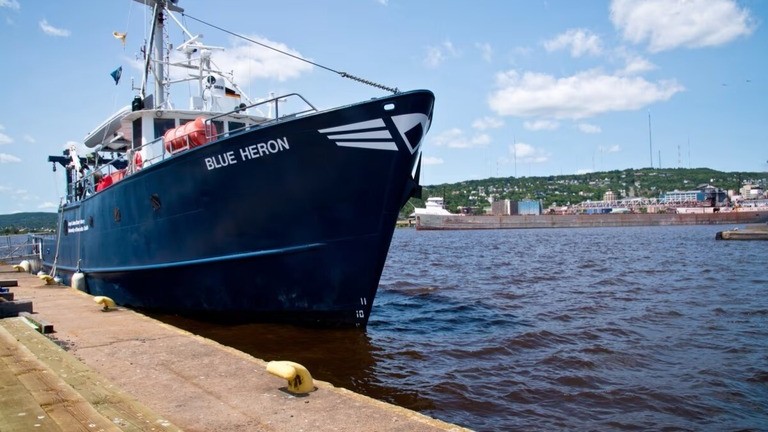
米国五大湖の観測を担う調査船「ブルーヘロン」より滲出した黒色の粘液を詳細に分析した結果、既知のものにとどまらず、未知の微生物種が多数含まれていることが明らかとなった。
According to a detailed analysis of the black slime that leaked from the research vessel Blue Heron, which observes the Great Lakes of the United States, it was found to contain not only known microorganisms but also many previously unknown ones.
。
It was identified that the source of this slime was the ship’s rudder shaft, which is the component that controls the direction of travel.
。
In September 2023, just after the Blue Heron completed its survey of blue-green algae in Lake Erie and Lake Superior, the crew discovered a black, tar-like substance leaking from the rudder shaft while the ship was docked.
。
Normally, the rudder shaft is a sealed space and hardly comes into contact with the external environment, so no one expects any organisms to be living there.
。
To reveal the strange properties of this slime, Doug Ricketts from the Great Lakes Observatory at the University of Minnesota Duluth collected samples and asked researchers to investigate.
。
According to the research team, many microorganisms with diverse forms have been discovered in this mucus, including new species that have never been identified before.
。
Currently, this substance is informally referred to as ShipGoo001.
。
According to an announcement by the University of Minnesota in June 2024, this slime may have developed in the anaerobic environment inside the rudder shaft.
。
Research team leader Cody Shake stated, We never imagined that microorganisms could exist in the sealed space of the hull, emphasizing the need to carefully sample similar slimy substances in the future while maintaining anaerobic conditions.
。
Furthermore, he also pointed out that as research progresses, it is possible that more new microbial species will be discovered.
。
DNA analysis revealed that some of the genetic material extracted from this slime originated from unidentified microorganisms, while other gene sequences were found to be related to microorganisms discovered in similar environments around the world, such as Mediterranean asphalt, hydrocarbon-contaminated sediments in Alberta, Canada, and from the coast of California to Germany.
。
Mr. Sheik stated, The environments where microorganisms similar to these are found are extremely diverse, but by comparing them from various perspectives, we can gain a deeper understanding of the functions and ecology of these organisms.
。
However, many issues remain unresolved, such as how this slime is produced inside the ship and whether it could cause biocorrosion corrosion by microorganisms to the ships iron hull.
。
The existence and development of this substance in a sealed environment suggests the possibility of a complex food web.
。
Boston University Associate Professor Jeffrey Marlow says, Since there are countless microorganisms on Earth, it is not surprising to discover new species.
。
The important points are where they were discovered, what kind of genomic characteristics and metabolic capabilities they have, and that academic interest depends on those factors.
。
Mr. Sheikh and his collaborators are also investigating the history of the blue heron to uncover the origin of the mucus.
。
Blue Heron was converted from a fishing vessel to a research vessel about 30 years ago, and aside from lubricants, no other materials have been used on the rudder shaft. However, it is necessary to consider the possibility that the previous owner used oil and the existence of microorganisms that may have been dormant for a long period.
。
Furthermore, Mr. Marlow also pointed out the possibility that mucus may have adhered to the rudder shaft due to clumps of organic matter known as marine snow.
。
Mr. Sheikh expressed his intention to continue clarifying the origin of the mucus, emphasizing the need to consider various scenarios, such as whether it occurred within the steering shaft from the beginning or adhered through other routes.
。
Mr. Marlowe stated, This discovery is due to our interest in and high awareness of microbiology, and it suggests that unknown microorganisms may exist in unexpected places close to us.
。
This article is an edited version of the original article published on August 3, 2025.
)


 Page d'accueil
 Vidéo
Vidéo
 Examen JLPT
 Dictionnaire
 Leçon
Leçon

 Sujet
Sujet