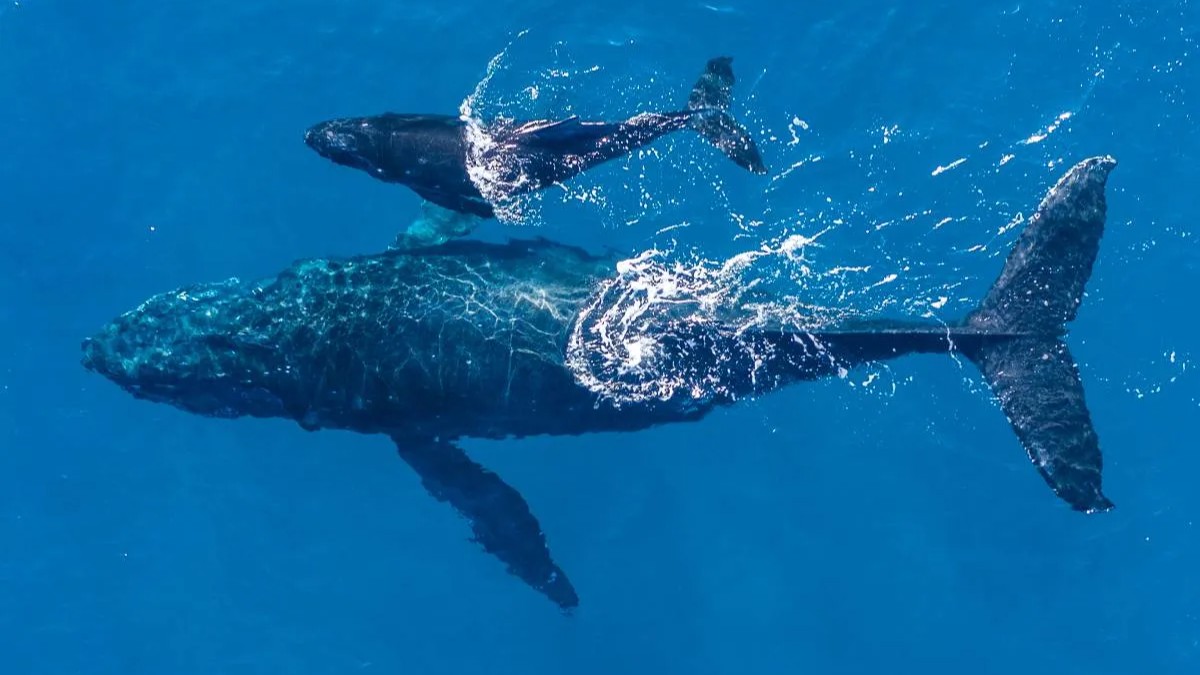
ハワイ諸島は、毎年冬季になると数千頭にも及ぶザトウクジラを迎え入れることで知られており、これらの哺乳類はアラスカから遥か彼方の島々へと長距離回遊を行う。
The Hawaiian Islands are famous for being visited by thousands of humpback whales every winter. These mammals travel long distances from Alaska to the distant islands mainly for breeding and raising their young.
。
Their grand journey is a major attraction not only for the locals but also for tourists.
。
There are several ways to get close to humpback whales: you can join a whale watching tour to observe them up close, or watch their breaching jumping behavior from observation decks or coastal parks.
。
これらの行動を目の当たりにすることはとても感動的ですが、その背後にある生態学について理解することで、体験の質がさらに高まります。
。
First of all, humpback whales stand out for having the longest migration distance among mammals on Earth, swimming about 4,800 kilometers from Alaska to Hawaii over the course of several weeks with almost no rest.
。
During this harsh journey, they eat very little and use the fat they stored during the summer as an energy source.
。
According to researchers, they travel an average of 80 to 110 kilometers per day.
。
The timing of their migration is closely related to breeding in the warm seas of Hawaii. Mother whales give birth to their calves in shallow waters, protect them from predators, and at the same time, teach them the survival skills they need before heading back north in the spring.
。
The gestation period of humpback whales is about one year, and they usually give birth every 2 to 3 years. This indicates that their breeding and recovery cycles are skillfully regulated.
。
Among the behaviors of whales, breaching—jumping out of the water—is especially spectacular. Scientifically, it is believed to serve various purposes, such as communication with other individuals, removing parasites, or simply playing.
。
The sight of a creature weighing as much as 25 to 40 tons leaping out of the water and creating a massive splash leaves a strong impression on observers.
。
Furthermore, the songs of male humpback whales can last up to 20 minutes and play an important role in breeding and social communication.
。
Each population has its own unique melody, and it is characteristic of this species that these melodies change over time.
。
Many sightseeing boats have installed underwater microphones so that tourists can listen to these sounds.
。
Other behaviors observed at the water’s surface include tail slapping, pectoral fin slapping, and “spyhopping” the act of raising the head above the water’s surface to observe the surroundings.
。
These behaviors are thought to express various emotions such as curiosity, aggression, and playfulness, and are still being studied by scientists today.
。
Once, humpback whales were on the brink of extinction due to overhunting, but thanks to the Marine Mammal Protection Act and other regulations, their population off the coast of Hawaii has made a significant recovery.
。
Currently, more than 10,000 whales come to Hawaii every year, which clearly shows the results of conservation efforts.
。
The humpback whale also has unique evolutionary features, such as long, curved pectoral fins and sensory nodules on its head.
。
The pectoral fins can reach up to one-third of their body length, helping them move flexibly and communicate.
。
The bump on its head senses water currents, helping it hunt and locate things.
。
Regarding individual identification, each humpback whale has a unique tail fluke pattern, and researchers use this to track individuals, migration routes, and family relationships.
。
As a result, the social and ecological structures in their lives, spanning up to 50 years, have gradually been revealed.
。
Furthermore, humpback whales can use low-frequency sound waves to communicate with each other over distances of many miles.
。
These vocal signals play a role in mating, social coordination, and maintaining contact during migration.
。
Regarding the observation location, the ʻAuʻau Channel on the island of Maui is famous for having the highest density of humpback whales.
。
This calm sea area is ideal for breeding and is one of the world’s top whale watching spots.
。
However, in winter, you can observe whales on all the islands of Hawaii.
。
Finally, a cooperative predation behavior called bubble net feeding was observed in some individuals.
。
This is a complex strategy in which many whales use bubbles to gather small fish and hunt together. This behavior has mainly been recorded in Alaska, but recent studies have also found instances of whales feeding while staying in Hawaii.


 Page d'accueil
 Vidéo
Vidéo
 Examen JLPT
 Dictionnaire
 Leçon
Leçon

 Sujet
Sujet