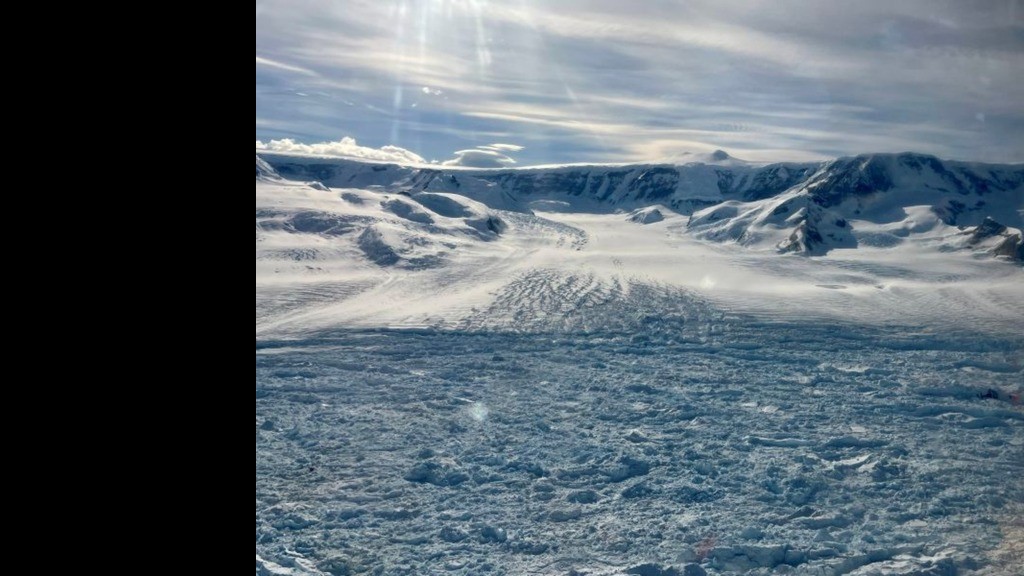
南極大陸に位置するヘクトリア氷河が、わずか2カ月という極めて短期間で、その規模のおよそ半分にまで縮小したことが最新の研究によって明らかになった。
According to the latest research, the Hektoria Glacier in Antarctica has shrunk to about half its original size in just two months, an extremely short period of time.
。
This phenomenon is an unprecedented case of glaciers retreating at a speed never seen before in modern history, and it has been pointed out that it could have a serious impact on global sea levels in the future.
。
The Hektoria Glacier has an area roughly equivalent to the city of Philadelphia, Pennsylvania, and is located at the tip of the Antarctic Peninsula.
。
The Antarctic Peninsula is a mountain range that extends from the Antarctic continent toward South America, and it is considered one of the regions on Earth where warming is progressing most rapidly.
。
Normally, glaciers that are grounded on the seafloor retreat only a few hundred meters per year, but Hektoria Glacier experienced a rapid retreat of about 8 kilometers in just one month, from November to December 2022.
。
This was confirmed by research results published in the journal Nature Geoscience.
。
Researchers warn that if larger glaciers retreat at the same rate, it could have a devastating impact on global sea levels.
。
There is so much ice in Antarctica that it could raise the global sea level by about 58 meters, so any changes here could have unpredictable effects on the Earths environment.
。
The research team at the University of Colorado Boulder conducted a detailed analysis of the fluctuations of the Hector Glacier using satellite images and aerial data.
。
The results indicate that the rapid retreat of the glacier proceeded through multiple stages.
。
In 2011, the bays around the glacier were covered with fast ice, and the glacier was relatively stable.
。
However, in 2022, the previously stable ice detached from the bay, the glacier became unstable, and the ice tongue disappeared.
。
ヘクトリア氷河が周辺の氷河よりもはるかに速く崩壊した要因として、氷河が海底の平坦な堆積物上を滑るように移動していることが挙げられる。
氷河が薄くなると上昇し、その下の裂け目に海水が入り込むことで圧力が高まり、大規模な氷板の分離(カービング)が連鎖的に発生し、急速な後退を引き起こすのである。
このような氷原の融解現象は、約1万5000~1万9000年前の最終氷期終焉期にも観察されたが、現代においてこれほどの速度で進行する例は前例がないと研究者は指摘している。
また、ヘクトリア氷河の後退には気候変動が大きく関与していると考えられる。
氷河に隣接する海域での海氷消失は、海水温の上昇と連動しており、波のうねりが定着氷を崩壊させることで、氷河が直接海水の影響を受ける状況が生じている。
コロラド大学地球科学観測センターのテッド・スカンボス上級研究者は、ヘクトリア氷河自体は南極の基準からすれば比較的小規模であり、その部分的な消滅が直ちに地球規模での海面上昇を引き起こすものではないとしつつも、同じメカニズムでより巨大な氷河が急速に後退する可能性を否定できないと強調している。
南極の氷河動態は、今後の地球環境を左右する重要な要素であることは間違いない。


 Home
Home
 Video
Video
 JLPT Test
 Dictionary
 Lesson

 Topic
Topic