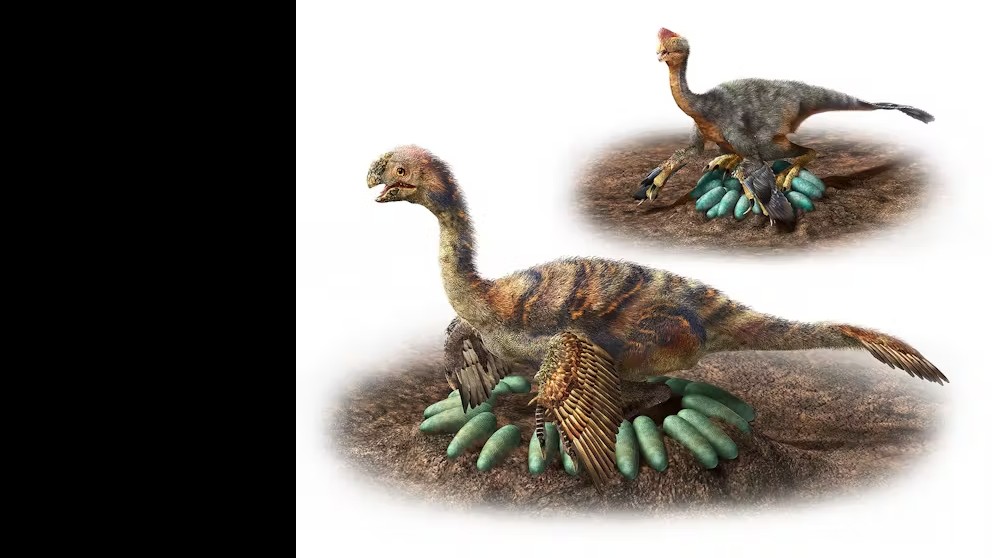
恐竜には、鳥類と同様に自らの体温を利用して卵を温めるという習性があったことが、近年の研究によって明らかにされている。
Recent studies have revealed that, like birds, dinosaurs also had the habit of using their own body heat to incubate their eggs.
。
This not only shows that dinosaurs were not merely an extension of reptiles, but also suggests that they had acquired a certain degree of warm-bloodedness.
。
The problem is, when did this behavior first appear?
。
It is possible that the habit of incubating eggs had already developed since the era of feathered dinosaurs.
。
By having feathers, it becomes easier to maintain body temperature, and indeed, thanks to that, the temperature of the eggs can also be kept stable.
。
Especially at night, when the temperature drops significantly, it is considered very reasonable for the parent bird to rest on the eggs in order to keep them warm.
。
In reptiles, the behavior of brooding and warming eggs has not been observed.
。
Their eggs may hatch naturally if daytime temperatures exceed 30°C, even if they are left unattended.
。
Instead, reptiles can only lay eggs during the hot season, and their habitats also tend to be limited to warm environments.
。
However, if feathered dinosaurs had a warm-bloodedness similar to that of birds, they must have been able to incubate their eggs at a stable temperature of about 35 to 40°C, regardless of seasonal or climatic conditions.
。
Therefore, it is presumed that they can continue to breed even in cold regions.
。
However, to be precise, since feathers are structured to prevent heat from escaping, they are not necessarily suitable for warming the outside.
。
したがって、実際に卵を温める際には、直接体温が伝わるような状態を作り出さざるを得なかったと考えられる。
実際、抱卵期の鳥では、卵と接触する腹部の羽毛が自然に抜け落ち、皮膚が露出することが知られている。
恐竜も同様の行動様式を持っていたとすれば、腹部の羽毛を失い、皮膚を卵に直接触れさせて温めていたに違いない。

















 Home
Home
 Video
Video
 JLPT Test
 Dictionary
 Lesson

 Topic
Topic